1. Where the Frogs First Sang (The Man Behind the Frogs) (1891)
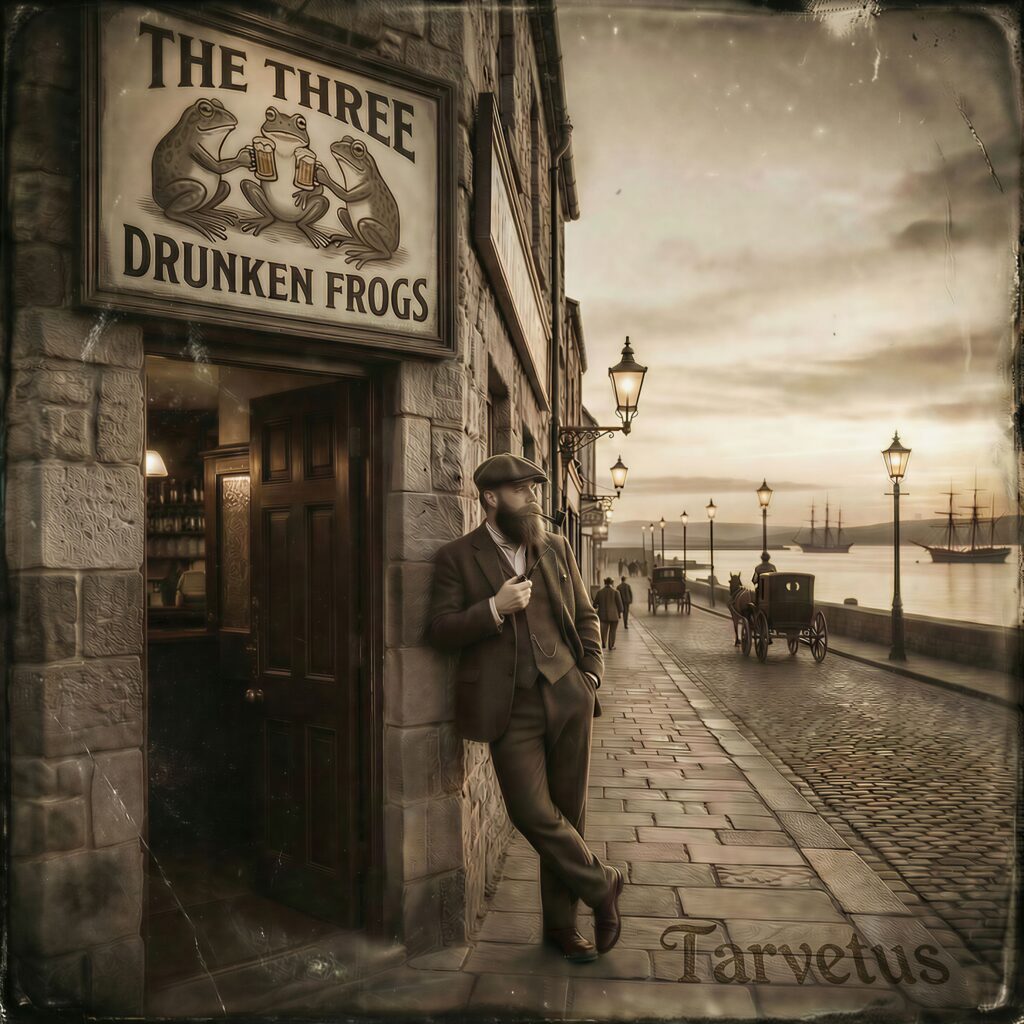
In the autumn of 1891, the heavy oak doors of The Three Drunken Frogs swung open for the first time, marking the start of a lineage that would define a small corner of Galway for over a century. Ted O’Shea, a man of quiet iron and a leather apron, established the house not merely as a place of business, but as a sanctuary where the salt of the earth could wash away the grime of the docks. Having arrived in Galway in the early months of that year to purchase the building, the twenty-eight-year-old Ted brought a peculiar temperament to the bar; unlike the loquacious regulars, he was a man of few words, preferring the sharp punctuation of a well-timed joke to long-winded oratory. Beside him stood Rosy, whose steady hand and shared vision turned the storefront into a home before the first children had even arrived to fill the upstairs rooms. On the calm, sunny evenings of that inaugural summer, Ted could often be found kneeling against the doorframe, his pipe glowing as he watched the sun dip below the Atlantic horizon. While the interior of the pub was a bastion of “good humor,” the songs of the era carried a sharp, mocking edge regarding the fall of Charles Stewart Parnell. The lyrics in the taproom didn’t target the doomed leader so much as the frantic moralizing of the priesthood, dryly praising Katharine O’Shea for her taste in gentlemen while the clergy fumed. This interplay of domestic peace and political satire established the “Frogs” as a place where the world’s scandals were shrunk down to a size that could be managed with a pint and a laugh.
2. The Wind Before the Dawn (The Frogs Still Sing in Galway Town) (1918)
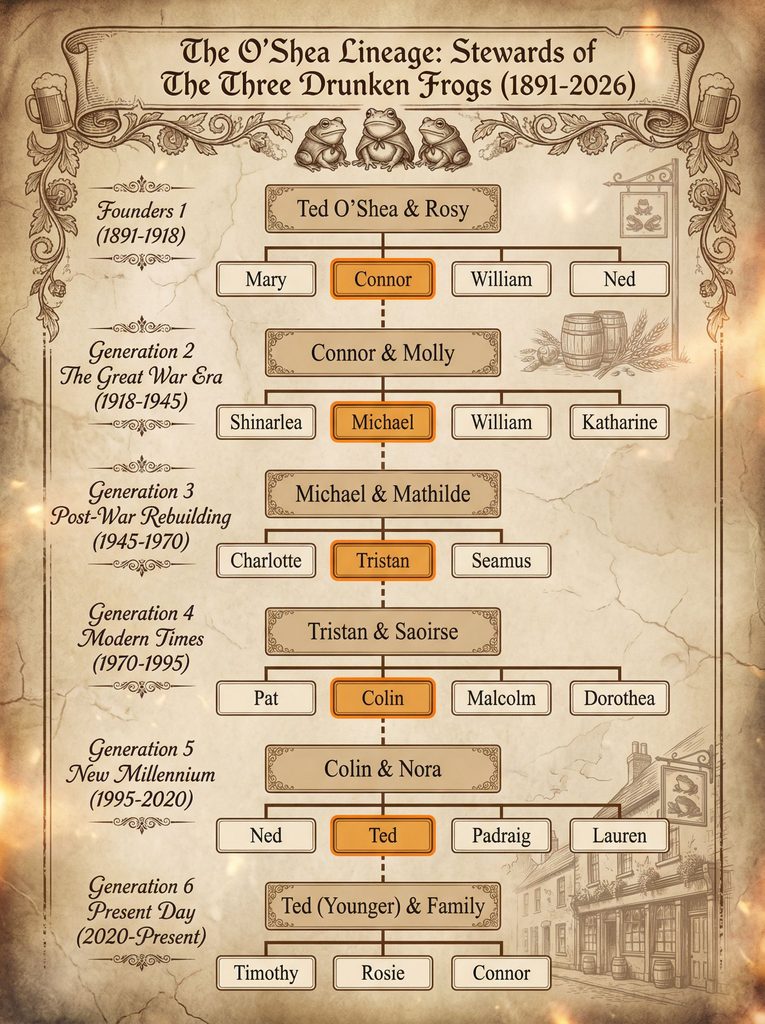
By the winter of 1918, the threshold of the pub had been worn smooth by nearly three decades of O’Shea stewardship. Ted and Rosy had seen their family grow into the pillars of the establishment, with their four children—Connor, Mary, William, and Ned—navigating a world caught between the trauma of the Great War and the fire of a new Republic. Connor had returned from the front wounded but resilient, settling into married life with Molly and preparing for both the management of the pub and the arrival of the first grandchild. The reputation of the house had traveled far beyond the Galway docks, with stories reaching as far as Dublin of the “warm and welcoming” sanctuary maintained by the family’s steady hands. While Mary’s blossoming courtship with William Kenmoor signaled a new chapter, the air in the taproom was thick with the electric tension of the December elections. As the patrons waited for the tallies, the songs shifted toward a bold speculation that Sinn Fein would sweep the boards, bringing new winds to blow across the Emerald Isle. In the height of the music, singers would shout to mournful faces in the crowd, urging them to look up because a victory was at hand. This moment of transition saw the pub acting as a communal heart, rallying every soul within its walls to toast to the brightest possible future for an Ireland on the verge of rebirth.
3. No Songs for Brothers Gone (No Talk of War in O’Shea’s House) (1924)
By 1924, a heavy, contemplative silence had settled over the ledger of the O’Shea family, as the scars of the Civil War reached into the very heart of the pub. While Connor and Molly’s young children, Michael and Shinarlea, brought a flicker of new life to the upstairs rooms, the absence of William—killed during the struggle—hung like a shadow over the hearth. Ned, having survived the conflict and a stint in prison thanks to Ted’s hard-won connections, returned to a house that had become a rare sanctuary of neutrality. Throughout the dark years of the Independence and Civil Wars, Ted had strictly enforced a ban on all political talk, unceremoniously ejecting any patron who broke the peace of the taproom. Though initially met with frustration, this iron-clad rule eventually earned the pub a reputation as the only ground in Galway where a man could escape the bitterness of the divide. The music of this era was inherently mournful, a low lament for the fallen and a bewildered questioning of why brothers had been forced to turn against one another. Yet, as the pints were drained, the songs began to shift toward a resolve to rise again, fueled by the memory of those lost.
4. Voices at the Doorframe (Mind Your Tongue, They Say) (1936)
By 1936, the stewardship of the house had officially passed to Connor and Molly, though the presence of the founders remained the quiet heart of the taproom. Ted, now an elder statesman, spent his days nursing a pipe and pouring occasional pints for the regulars who had grown grey alongside him, while Rosy’s visits from the family quarters were treated as minor celebrations. The next generation had blossomed, with eighteen-year-old Michael and fifteen-year-old Shinarlea already weaving themselves into the daily rhythm of service. The return of Ned from America, carrying the sophisticated air of a successful businessman and a touch of Cuban pride, added a new, cosmopolitan energy to the O’Shea family table. However, the air in the pub was often charged with a burgeoning frustration as the decade’s strict censorship and the stifling limitations on women’s expressions began to grate against the spirits of the household. Mary and young Shinarlea were particularly vocal in their dissent, turning the back rooms into a forum for like-minded souls to debate the tightening grip of social orthodoxy. The music of these nights took on a sharp, satirical edge, with singers crafting bold jokes about the hypocrisy of the clergy, mocking those who preached pious words from the pulpit while walking very different paths in the dark.
5. Shadows Without News (The News Don’t Reach the Frogs) (1944)
By 1944, the long, stretching shadows of the global conflict had reached even the most secluded corners of Galway, casting a somber pall over the daily rituals of the house. Ted O’Shea, now a venerable figure of the old world, emerged only on those specific evenings when the Atlantic sunset promised a particular clarity, content to sit in his accustomed silence and watch his grandson Michael learn the business. Michael’s marriage to Mathilde, a Dublin woman of sharp intellect, had already added two small branches to the family tree—young Tristan and baby Charlotte—who represented a fragile hope amidst the rationing and hardship of the Emergency. Despite the scarcity of the times, the pub remained the unwavering anchor for the entire O’Shea clan, who gathered every Sunday afternoon to reinforce the bonds of kinship. The music of these years was characterized by a profound, thoughtful sadness, reflecting a deep-seated frustration with the tight veil of censorship that left the patrons starved for true information about the world’s upheaval. Voices in the snug would lower as they indirectly questioned the silence of the state, wondering how Eamon de Valera could preside over such stifling restrictions after the collective sacrifices made during the struggle. In the dim light of 1944, the “Frogs” stood as a quiet fortress of shared grief and whispered defiance.
6. Letters Across the Water (The Stools That Stand Empty) (1953)
By 1953, the passage of time had etched itself into the very grain of the bar, as Ted O’Shea transitioned into a venerable, quiet figure of the old world. Though very old and leaning heavily on his walking stick, his arrival in the taproom with his signature pipe remained a daily benediction, drawing cheers from the regulars that never failed to pull a weary smile from his face. On the rare, golden evenings when Rosy accompanied him, the atmosphere transformed into one of pure jubilee. While Connor and Molly remained a steady presence, the management had passed to Michael and Mathilde, whose three children—Tristan, Charlotte, and the young Seamus—now filled the hallways with the sounds of a new generation. The family table felt slightly smaller, however, as letters arrived from America carrying news of William and Katharine, who had joined the long line of those seeking fortune across the Atlantic. The music of this era was a heavy, heart-wrenching lament for those “staying behind,” reflecting a landscape where so many friends and kin were being lost to the ship’s hull. Amidst the sorrow, there was a sharp, whispered discontent regarding the country’s stagnation and the stifling grip of the church. Yet, as the pints were drained, a flicker of modern hope remained, with many in the snug pinning their dreams on the rising influence of Sean Lemass to break the silence.
7. The Night the Frogs Roared (Back on Our Feet at the Frogs) (1966)
By 1966, the original architects of the house, Ted and Rosy, had passed into the realm of legend, their names invoked in every toast that sought to honor the foundations of the neighborhood. Connor, now an elder himself, had gracefully adopted his father’s old habit, often found leaning against the doorframe with a pipe in hand, watching the Galway sun dip below the horizon. Under Michael’s exuberant leadership, the “Frogs” had entered a golden age of popularity, its stools perpetually occupied by a crowd drawn to his infectious joy and the modern energy of the room. A television now flickered in the corner, a technological marvel that turned the taproom into a roaring stadium whenever the Galway football team took the field. The music of these nights broke away from the somber laments of the previous decade, surging with a fast, enthusiastic rhythm that mirrored the nation’s newfound confidence. Patrons raised their glasses to Sean Lemass, credited with bringing Ireland back to its feet and igniting the ambitions of a younger generation who felt the world finally opening up to them. Amidst the laughter, sharp-witted jokes were aimed at Archbishop McQuaid, whose rigid traditionalism seemed increasingly out of step with the vibrant, beating hearts of the youth.
8. When the Fog Answered Back (No Trouble in the Frogs Tonight) (1976)
By 1976, the hearth of the “Frogs” served as a bridge between the fading echoes of the old world and the electric, often turbulent, energy of the modern era. Connor, now a quiet fixture of the house, spent his evenings by the fireplace, a silent witness to the “fuzz” of a pub that had become a bustling institution under Michael’s joyful leadership. The national mood, however, was one of sharp, witty cynicism, as the shadow of Bloody Sunday and the ongoing conflict in the North sparked a weary anger. In the taproom, the regulars raised their glasses with a stern hope that the Provos would leave Galway in peace, having seen enough blood spilled on their own streets during the Civil War to last ten lifetimes. Amidst this heavy political weather, the pub remained a stage for the eccentric and the legendary, with stories circulating of the night Luke Kelly graced the bar while the local character Seamus demanded a samba beat to better punctuate his recitals of Yeats. Seamus, a fifty-eight-year-old force of nature and dear friend to Michael, became the subject of much good-natured laughter after a particularly foggy night saw him vanish into the mist, only to be found drifting aimlessly on Galway Bay the following morning. As the fog rolled in off the Atlantic, the pub stood as a warm, defiant light, waiting for the fishermen to row the wanderers back home.
9. We’re Still Standing, Aren’t We (We’re Still Standing at the Frogs) (1989)
By 1989, the “Frogs” had become a living monument to endurance, though the original branches of the O’Shea tree were beginning to thin. Connor had passed on, leaving only Mary—now a formidable ninety-three years of age—to carry the direct memory of the 19th-century opening. The recent passing of Seamus had left a hole in the heart of the snug, yet his spirit remained indestructible through a new tradition where patrons competed to quote Yeats in his signature, “athletic” style. While Michael still moved through the room with a pint in each hand, the daily weight of the house rested on Tristan, with young Colin now introducing the first flickers of modern technology to the ancient bar. The arrival of Colin and Nora’s children—a new, two-year-old Ted and the infant Ned—brought a profound sense of “The Return” to the family quarters, as if the founders themselves were reappearing to witness the next century. The music of this era was marked by a gritty resilience, a “we’re still standing” anthem that acknowledged the hardships of the late eighties while finding hope in the continuity of the O’Shea name. Sharp, cynical jokes at the expense of Charles Haughey rippled through the crowd, serving as a reminder that while politicians might stumble, the pub remained a steady light in the fog.
10. After Midnight, We Believe (After Midnight at the Frogs) (1994)
The year 1994 brought a thunderous, electric energy to the “Frogs,” as the pub stood at the crossroads of ancient tradition and a digital future. Michael, now the elder patriarch, often retreated to the cobblestones to smoke his pipe, his eyes searching the Galway mist as if expecting the ghostly “preaching” of his dear friend Seamus to drift in from the bay. Inside, the dynamic had shifted; Tristan managed the chaos of the bar with a booming voice and a sharp tongue, while Colin grappled with the arrival of the first computer. After midnight, the taproom would erupt into a frantic, sweat-soaked energy, with patrons attempting the “Riverdance” steps seen at Eurovision, their boots thundering against the old floorboards after many pints of courage. The music of these nights was raw and unfiltered, with the crowd nearly cursing the church as the first waves of modern scandals began to break the long silence of the pews. Yet, the air was also thick with a fierce, yelling joy as the news of the ceasefire in the North sparked a hope that the “Troubles” were finally receding. There was a collective, roaring agreement that the lean years were over; as the Celtic Tiger began to stir, the “Frogs” transformed into a high-octane sanctuary for a nation finally ready to celebrate its own awakening.
11. Dancing Toward the Light (Golden Evenings at the Frogs) (2006)
By 2006, the “Frogs” was basking in the golden, albeit precarious, glow of the new millennium. Michael, now the silver-haired patriarch, had moved his permanent station to the fireplace; though he moved slowly, he would instantly stir to life whenever the spirit of Seamus took over the room, quoting Yeats with a voice that still carried the resonance of the docks. Tristan remained a fixture behind the counter, while under Colin’s management, a new tension had emerged between the old wood of the bar and the digital horizon, with nineteen-year-old Ted arguing for the internet to be brought into the pub. The atmosphere of these years was light, almost ethereal, with the music taking on a polished, pop-infused melody that echoed the sounds of The Corrs. While the songs celebrated the unprecedented prosperity of the era, Michael’s seasoned voice could still be heard in the quiet moments, warning the family to save for the “darker times” ahead. The taproom was filled with cynical, good-natured laughter regarding the “brown envelopes” of the political class and the strange new reality where Galway locals were regularly flying to Spain to warm their bones.
12. The Door Is Always Open (The Frogs Are Still Singing) (2026)
The final chapter of the chronicle brings the saga into the present day, where the air in the “Frogs” is thick with the ghosts of the past and the vibrant energy of the future. Michael has passed into memory, leaving his chair by the hearth to a very old Tristan, who now sits where his father and grandfather once did. While Colin remains a steady hand at the bar, the daily pulse of the house is now driven by the “New Ted,” whose presence is so reminiscent of the original founder that the oldest regulars often find themselves slipping into the past when they look at him. Ted’s children—Timothy, Rosie, and Connor—represent the seventh generation to call these stone walls home, their laughter echoing through the taproom just as it has for 135 years. The music of this modern era is a bittersweet fusion of traditional Irish roots and contemporary indie spirit, a soundscape that travels back through the decades to touch upon the first Ted’s quiet sunsets and the second Connor’s wartime resilience. Despite his constant motion, Ted still carves out a moment to lean against the doorframe and smoke a pipe that many swear belonged to the man who arrived in 1891. The chronicle concludes with a powerful, collective refrain: The Three Drunken Frogs remains a sanctuary, its doors eternally open to every friend, traveler, and neighbor who seeks the warmth of a fire that has never been allowed to go out.